- Plot No. 453-454, HSIIDC, Industrial Area, Saha, Haryana 133104

Fruit Grading Machine: The Smart Solution for Consistent Fruit Quality

Vertical Bucket Elevator Manufacturer: Features, Benefits & Industrial Applications
June 18, 2026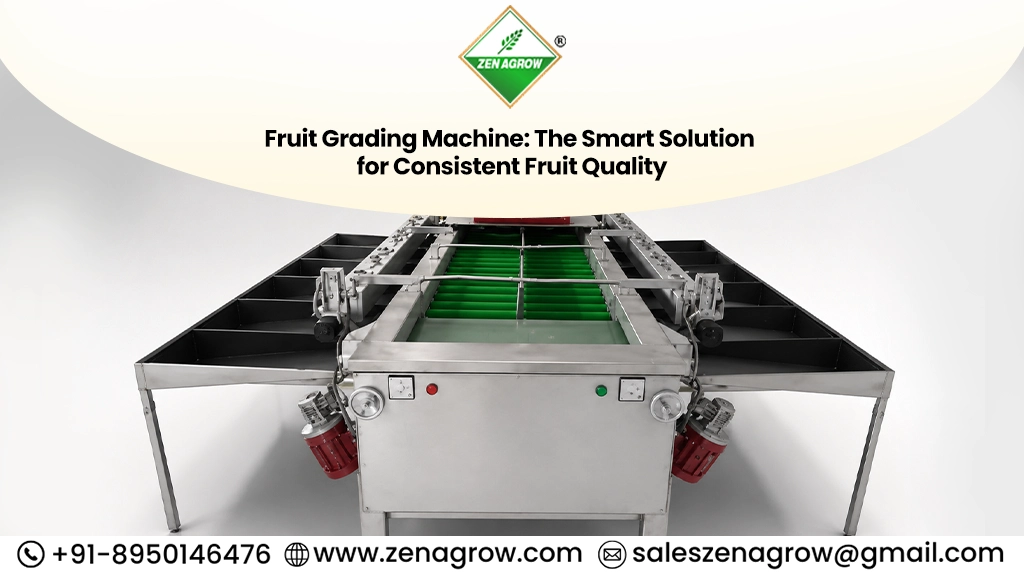
Farmers can expect to harvest a wide range of fruits from any one given farm. Even at the same orchard, fruits can be significantly different in terms of their size, weight, color, and overall appearance. As these differences in nature are not unusual, they also create large issues for gardeners when selling, packing, and exporting fruits.
At present, buyers are looking for consistency. Buyers want (and need) to find a certain type of fruit, like apples, oranges, mangoes, and tomatoes, that are all uniformly classified, as uniformity in grading will have a significant impact on the person's overall willingness to purchase. Because of this reason, fruit grading machines play a very important role in post-harvest processing.
Instead of relying on manual sorters, many types of grading machines can be utilized to help the farmer and the fruit processor to classify their produce efficiently, effectively, and with the least amount of waste possible.
The Importance of Grading & Its Effects on Quality
When you harvest your crop, it is only part of the process. Once you harvest your crop you need to grade your fruit, so that it will be ready for sale to your wholesalers, retailers, or consumers.
The benefits of grading are:
- Maintain consistent product quality
- Improve the efficiency of packaging
- Eliminate the need for excessive manual handling
- Meet market and export specifications
- Increase customer satisfaction
- Increase the price a person will pay for premium grade fruit
In short, good quality fruit generally equals good business; better quality fruit typically translates to more revenue.
How does a fruit grading machine work?
It’s basically an automatic unit that sorts fruits based on whatever you set, like size, weight, diameter, or even quality, and then it just keeps doing it over and over, pretty smoothly.
In most cases, the workflow looks like this, kind of loosely:
Feeding: Freshly picked fruits get loaded into the system, usually via a conveyor or some feeding track. Sometimes the operator adjusts the flow so the line doesn’t get jammed.
Inspection: Then sensors, or a mechanical grading arrangement, checks each piece one by one. The fruit will be checked as per your solution, like how big it is, how heavy it feels, or how it looks for quality.
Sorting: After the proper inspection is done the machine send the same fruits to different section. It separates them automatically, so no one is standing there sorting manually all day.
Collection: Finally, each grade ends up in its own collection channel, bin, or chute. This makes packing and transport more orderly, and honestly a lot less chaotic.
Overall, compared with hand grading, this automated method gives better speed and steadier results, not just faster, but also more consistent across batches.
Fruits that are commonly graded using these machines
These fruit grading machines can handle a lot of produce, including:
- Apples
- Oranges
- Mangoes
- Tomatoes
- Lemons
- Guavas
- Pomegranates
- Onions
- Potatoes
And other round as well as semi round fruits and vegetables
Why Farmers and Businesses Prefer Automated Grading
The process of manual grading itself can become a bottleneck—slow, inconsistent, and labor intensive. Automation offers several advantages.
- Saves Time: Large quantities of fruits could be graded much faster than when done manually.
- Improves Accuracy: Every single fruit will be graded on the basis of the same standards thus there would be no chances of human error
- Reduces Labour Requirements: Less manual handling translates to less labour dependency and greater operating efficiency.
- Better Product Presentation: Uniform grading makes for attractive packaging appealing to both the buyer and retailer.
- Supports Business Growth: The faster grading can be done with these machines which helps you cater large production volumes while maintaining good quality.
These are some of the key features that you should look out for when buying a fruit grading machine.
Look for:
- Adjustable grading options
- Durable machine construction
- Gentle fruit handling
- Easy operation
- Low maintenance requirements
- Energy saver performance
- High processing capacity
Choose the right equipment and increase your productivity for years to come!
Utilization within the Agricultural Industry
Machines that Grade Produce (or Fruit) can be utilized within many different types of agricultural/food processing operations including:
- Farms that Grow Produce (like Orchards)
- Production/Packaging Facilities
- Crop Coop and Agri-Business Providers
- Food Processing Companies
- Exporting Companies
- Cold Chain
- Wholesale Fruit Marts
As such, the versatility of this type of grading machine makes it a key variable to consider when making an investment in fresh fruit.
Why Work with Zen Agrow?
Zen Agrow realizes that as much as post-harvest production is dependent upon crop production; so too is the successful post-harvest management of crops to ensure that degree of success.
The goal of our products is to enhance productivity while maintaining quality throughout all phases of production.
- Consistent machine Performance
- Easy using Operation
- Efficient Grading Systems
- Durable Product Designs
- Customer Service that meets or exceeds expectations
Through the application of our products, we can provide practical solutions that help mitigate losses, increase production efficiency for the producer and reduce overall costs to those utilizing the related products along the supply chain.
Fruit Grading Systems of the Future
The technology of Agriculture is becoming more prevalent with the increasing labour costs and growing demand for the best products; automated grading machines will now become critical components within Agricultural production.
The farming, exportation and processing of fruit will soon require all 3 Elements of a 'Fruit Grading Machine' as an asset that guarantees consistency and quality and assures the longevity of financial benefit of farmers, exporters and processors.


 English