- Plot No. 453-454, HSIIDC, Industrial Area, Saha, Haryana 133104

Seed Grading Machine Manufacturers in India

Grain Grading Machine
September 16, 2026
Wheat Cleaning and Grading Machine
September 21, 2026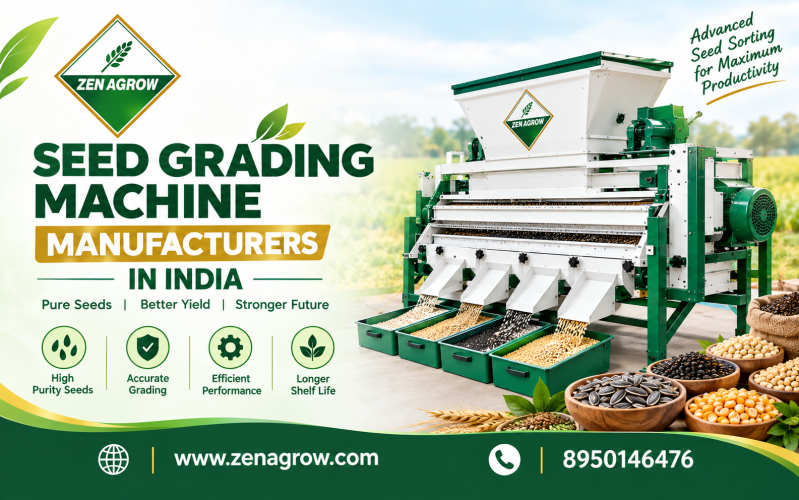
Seed quality is an important part of successful agriculture. Before seeds reach farmers, they often need to go through several processing stages to remove unwanted material, separate different sizes, and prepare the final seed lot for treatment, packaging, storage, and sowing. A seed grading machine is one of the important machines used in this process. India has a large agricultural production base, creating a significant need for efficient agricultural processing equipment. According to the Government of India’s latest final estimates for 2024-25, the country produced 357.73 million tonnes of foodgrains. The same official publication reports horticulture production of 369.05 million tonnes based on the third advance estimate for 2024-25. With such a large agricultural sector, efficient seed and grain processing equipment has an important role in improving post-harvest operations. This is why businesses increasingly look for reliable seed grading machine manufacturers in India that can provide machinery according to crop type, processing capacity, and grading requirements.
What Is a Seed Grading Machine?
A seed grading machine is equipment designed to separate seeds into different groups according to physical characteristics such as size, thickness, length, weight, density, or shape.
Seeds collected after harvesting may not have identical physical characteristics. A seed lot can contain large and small seeds, broken seeds, immature material, weed seeds, crop residues, and other unwanted particles. Processing equipment helps separate these materials and organize the usable seed into more consistent fractions.
FAO explains that seed processing can include cleaning, drying, size grading, treating, storage, and packaging. Size grading is particularly useful for obtaining greater uniformity within a seed lot.
Why Is Seed Grading Important?
Seed grading is an important operation because uniformity can make seed handling and subsequent processing more efficient.
1. Improves Physical Uniformity
Grading separates seeds according to selected physical characteristics. This can create more uniform fractions for further processing.
2. Supports Mechanical Sowing
Uniform seed size can be useful for mechanical sowing. FAO notes that size grading can assist mechanical sowing and help produce more even groups of seeds.
3. Helps Remove Undesirable Fractions
Depending on the machine and processing line, grading can separate undersized, oversized, broken, or otherwise unsuitable material.
4. Supports Further Seed Processing
After grading, suitable seed fractions can move to processes such as seed treatment, packaging, storage, or additional separation.
5. Reduces Dependence on Manual Sorting
For commercial volumes, mechanical grading can handle material more consistently than manual separation.
How Does a Seed Grading Machine Work?
The working principle depends on the type of grader being used. However, a typical process follows several basic stages.
Feeding
Seeds are introduced into the machine through a controlled feeding system. Consistent feeding helps maintain stable processing.
Separation
The seed material moves through screens, cylinders, air systems, or other separation mechanisms. Each system works according to a particular physical characteristic.
Grading
Different fractions are separated according to the selected settings. For example, screens can separate according to width or thickness, while an indented cylinder can separate according to length.
Collection
Separated seed fractions leave the machine through individual outlets and can be collected for further processing.
The exact screen size, machine settings, and processing configuration should be selected according to the crop and seed characteristics. FAO’s guidance on wheat seed processing, for example, describes the use of screens for width and thickness, indented cylinders for length, and air separation for lighter materials.
Types of Seed Grading Equipment
Different crops require different separation methods. Some commonly used technologies include the following.
Screen or Sieve Grading
Screen-based machines separate seeds according to dimensions. Different perforations can be used to obtain the desired fractions.
This method is useful when the main difference between seed groups is width or thickness.
Indented Cylinder Grader
An indented cylinder is primarily used for length-based separation. The rotating cylinder contains small pockets or indentations that can lift material according to its length.
FAO describes indented cylinders as equipment capable of separating seed mixtures according to length and also notes their use in agricultural seed grading.
Air Separation
Air separation uses an airflow to separate lighter materials from heavier seed. Dust, chaff, light particles, and partially filled seeds can behave differently in an air stream.
Gravity Separation
Gravity-based equipment separates material according to differences in density and related physical characteristics. It is generally used when basic size separation is not sufficient for the required processing objective.
Integrated Seed Processing Systems
Commercial seed businesses may combine several machines into a complete processing line. A system can include pre-cleaning, fine cleaning, grading, gravity separation, seed treatment, conveying, weighing, and packaging.
Benefits of Using a Seed Grading Machine
A seed grading machine can make seed processing more organized, consistent, and efficient. Instead of depending entirely on manual sorting, processors can use mechanical separation to divide seeds according to selected physical characteristics such as size, thickness, length, or density.
Improved seed uniformity is one of the main benefits of mechanical grading. Separating seeds into more consistent fractions can make them easier to handle during further processing, packaging, and other seed preparation operations.
Higher processing efficiency is another advantage. A suitable machine can handle larger quantities of seed than manual sorting, helping processing businesses reduce repetitive labor and maintain a more consistent workflow.
Better separation control allows operators to adjust the machine according to crop type and processing requirements. This flexibility can be useful when handling different varieties or seed lots with varying physical characteristics.
Reduced manual effort can also improve overall workplace productivity. Mechanical grading minimizes the need for continuous hand sorting and allows workers to focus on other important processing activities.
For commercial seed processors, selecting equipment from reliable seed grading machine manufacturers in India can help create a practical processing setup based on crop type, required capacity, available space, and desired grading results.
Current Agricultural Scenario in India
The scale of Indian agriculture highlights the importance of efficient processing infrastructure.
The Government of India’s Agricultural Statistics at a Glance 2024-25 reports:
- Foodgrain production: 357.73 million tonnes in 2024-25
- Kharif foodgrain production: 169.46 million tonnes
- Rabi foodgrain production: 169.17 million tonnes
- Horticulture production: 369.05 million tonnes based on the third advance estimate for 2024-25
- Net area sown: 141.71 million hectares based on 2022-23 land-use statistics
- Gross cropped area: 219.36 million hectares based on 2022-23 statistics
These figures are agricultural production statistics, not seed-processing volumes. However, they demonstrate the enormous scale of India’s agricultural sector and the need for suitable machinery for handling and processing agricultural products.
The Department of Agriculture and Farmers Welfare has also published the final 2024-25 production estimates and continues to release updated production estimates for 2025-26.
How to Choose Seed Grading Machine Manufacturers in India
Choosing a manufacturer requires more than comparing machine prices. Businesses should evaluate the complete technical and operational requirements.
Machine Capacity
Determine the required processing capacity before selecting the machine. Capacity should be based on daily processing requirements, seasonal workload, and future expansion.
Crop Compatibility
Different seeds have different physical properties. Discuss the crop, seed variety, seed dimensions, moisture condition, and impurities with the manufacturer.
Grading Principle
Identify whether the application requires size, thickness, length, weight, density, or combined separation.
Machine Construction
A robust structure and suitable machine components are important for agricultural processing environments where equipment may operate for extended periods.
Ease of Maintenance
The machine should provide convenient access for cleaning, inspection, adjustment, and routine maintenance.
Technical Support
Installation guidance, operating instructions, spare-parts availability, and after-sales technical support are important considerations for commercial users.
Complete Plant Integration
If the machine is going into an existing processing plant, confirm that its feeding, discharge, capacity, and layout can integrate with other equipment.
Zenagrow – Agricultural Machinery Manufacturer in India
Zenagrow is an Indian company involved in agricultural machinery and processing equipment. For businesses looking for agricultural machinery manufacturers in India, Zenagrow provides machinery solutions designed for agricultural processing applications.
A complete seed-processing setup may require more than a grading machine. Depending on the crop and desired final output, businesses may require cleaning, grading, separation, conveying, treatment, and packaging equipment.
Zenagrow can be approached to discuss the specific processing requirements, crop type, capacity, and plant configuration before selecting suitable machinery.
Zenagrow
Plot No. 453-454, HSIIDC, Industrial Area, Saha, Haryana 133104, India
Email: saleszenagrow@gmail.com
Phone: 89501 46476
Applications of Seed Grading Machines
Seed grading machines can be used across different agricultural processing applications, including:
- Commercial seed processing
- Seed cleaning and conditioning plants
- Agricultural processing units
- Farmer producer organizations
- Seed companies
- Grain and pulse processing facilities
- Research and seed-processing operations
Depending on the machine configuration, applications may include wheat, paddy, maize, pulses, chickpea, soybean, mustard, sunflower, sesame, and various other agricultural seeds.
However, the same machine settings should not automatically be used for every crop. Testing representative samples is an effective way to determine the appropriate grading configuration.
Benefits of Modern Seed Grading Technology
Modern mechanical grading can offer several practical benefits when the equipment is correctly selected and operated.
Higher processing consistency: Mechanical separation can provide more repeatable results than manual sorting.
Improved workflow: Grading can be integrated with cleaning, treatment, conveying, and packaging operations.
Reduced manual effort: Mechanized processing can reduce repetitive sorting work.
Better seed handling: Uniform fractions can be easier to handle during subsequent operations.
Scalable processing: Properly selected equipment can support commercial processing requirements and future expansion.
Research indexed through FAO AGRIS has also reported improvements in physical purity and germination in a wheat seed-processing study using air-screen cleaning and specific-gravity separation. This demonstrates the potential contribution of appropriate processing equipment, although results naturally depend on the initial seed lot and processing conditions.
Seed Grading Does Not Replace Seed Quality Testing
An important point for seed businesses is that physical grading alone does not guarantee overall seed quality.
Seed quality can involve germination, physical purity, varietal purity, moisture, seed health, and other characteristics. FAO’s seed-quality guidance covers quality assurance across production, inspection, testing, packaging, storage, and distribution.
Therefore, seed grading should be considered one part of a broader seed-processing and quality-management system.
Future of Seed Grading Machinery in India
Seed-processing machinery is becoming increasingly important as agricultural businesses look for more organized and efficient processing systems.
Future processing plants are likely to focus on better automation, controlled feeding, adjustable separation, improved monitoring, energy efficiency, and integration between different machines.
For smaller businesses, compact and practical equipment can provide an appropriate solution. Larger seed companies may require integrated processing plants capable of handling multiple crops and higher volumes.
The most suitable technology will depend on the business rather than simply the latest available machine. Crop characteristics, production volume, available space, power supply, desired grading accuracy, and future expansion should all be considered.
Conclusion
Seed grading is an important operation in modern seed processing. By separating seeds according to physical characteristics such as size, thickness, length, or density, grading equipment can help create more uniform seed fractions and support subsequent processing operations.
India’s large agricultural production base makes efficient agricultural machinery increasingly relevant. With 357.73 million tonnes of foodgrain production in 2024-25, according to the Government of India, the country’s agricultural processing ecosystem operates at a very large scale.
For businesses searching for seed grading machine manufacturers in India, the right choice should be based on technical requirements rather than price alone. Crop compatibility, capacity, grading method, machine construction, maintenance, technical support, and plant integration are all important factors.
As one of the agricultural machinery manufacturers in India, Zenagrow provides agricultural machinery solutions for businesses involved in seed and agricultural processing. Before purchasing equipment, businesses should discuss their crop, sample material, required capacity, grading requirements, and complete processing workflow with the manufacturer. For additional guidance on seed processing principles and equipment, businesses can refer to the FAO Seed Processing Resources.
Frequently Asked Questions
1. What is a seed grading machine?
A seed grading machine is agricultural processing equipment used to separate seeds into different fractions according to characteristics such as size, thickness, length, weight, or density.
2. Why is seed grading important?
Seed grading helps create more uniform seed fractions and can support operations such as mechanical sowing, seed treatment, packaging, and storage. FAO identifies size grading as a useful practice for seed uniformity and mechanical sowing.
3. What is the difference between seed cleaning and seed grading?
Cleaning primarily removes unwanted materials such as dust, chaff, stones, weed seeds, and crop residues. Grading separates seed material according to specific physical characteristics such as size, thickness, length, or density.
4. Which seeds can be processed using a seed grading machine?
Depending on the machine design and settings, grading equipment can be used for crops such as wheat, paddy, maize, pulses, soybean, mustard, sunflower, sesame, and other agricultural seeds.
5. How do I select the right seed grading machine?
Consider the crop, processing capacity, seed dimensions, moisture, impurities, required number of grades, grading principle, available space, power requirements, and future expansion plans. Testing a representative seed sample can also help determine suitable machine settings.
6. Can seed grading machines be integrated into a complete processing plant?
Yes. A grading machine can be incorporated into a larger processing line containing equipment for pre-cleaning, cleaning, separation, conveying, seed treatment, weighing, and packaging, depending on the plant’s requirements.
7. Why choose experienced agricultural machinery manufacturers in India?
An experienced manufacturer can help match the equipment with the crop, processing capacity, plant layout, and separation requirements. Technical support and machine customization can also be important for businesses developing or expanding a seed-processing facility.

 English