- Plot No. 453-454, HSIIDC, Industrial Area, Saha, Haryana 133104

Grain Grading Machine

Grain Separator Machine
September 12, 2026
Seed Grading Machine Manufacturers in India
September 18, 2026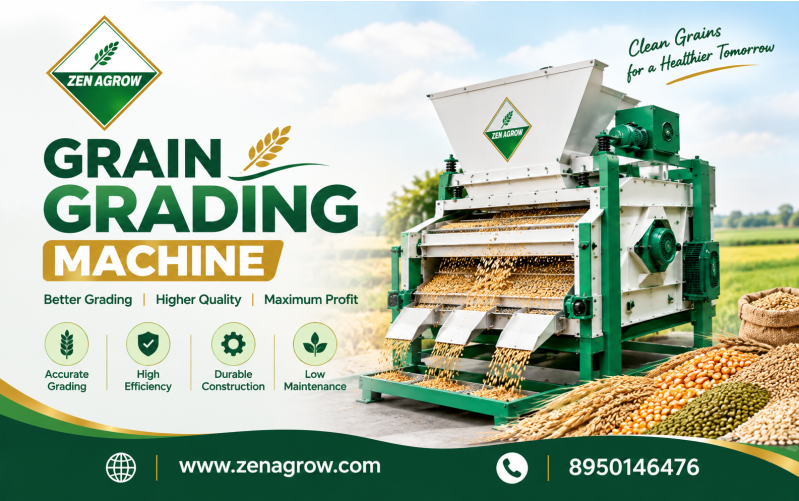
Grain quality is no longer a side concern for farmers, traders, and processors. In fact, it is often the difference between a profitable harvest and a rejected consignment. As export standards tighten, buyers now demand uniform, contamination-free grain. As a result, the humble sorting basket and manual hand-picking methods have become relics of the past. This is where a grain grading machine steps in as a true game-changer.
Whether you run a small family farm, a mid-sized warehouse, or a large-scale processing unit, investing in the right grain grading machine can transform how you handle post-harvest operations. In this comprehensive guide, we will explore everything you need to know about grain grading machines. This includes how they work, their types, their benefits, and why they have become indispensable equipment for farmers and processors across India and beyond.
What Is a Grain Grading Machine?
A grain grading machine is a mechanical device engineered to sort grains. It classifies them based on size, shape, weight, and density. Unlike basic cleaning equipment, which only removes dust, chaff, and foreign particles, a grading machine goes a step further. It separates grains into different quality categories. As a result, only uniform, healthy, and market-ready grains move forward in the supply chain, while broken, undersized, or damaged grains are filtered out.
The core purpose of a grain grading machine is simple: to standardize grain output. This helps farmers and traders meet strict quality benchmarks set by mandis, exporters, and food processing companies. Because agriculture remains the backbone of the rural economy, such machines have become essential tools for improving farm income and reducing post-harvest losses.
Why Grain Grading Has Become Essential in Modern Agriculture
Post-harvest losses due to poor sorting, contamination, and inconsistent quality can run into double digits as a percentage of total yield. Often, a significant portion of these losses can be traced back to inadequate grading infrastructure at the farm and warehouse level.
Here are some reasons why grain grading has become a non-negotiable step in the agricultural value chain:
- Rising export standards: International buyers reject shipments that don’t meet uniformity and purity benchmarks. Therefore, a reliable grain grading machine is essential for exporters.
- Better market pricing: Graded grain consistently fetches higher prices in mandis and open markets, compared to ungraded, mixed-quality lots.
- Consumer demand for quality: Retail and institutional buyers increasingly prefer visually uniform, clean grain for packaging and processing.
- Government procurement norms: Agencies procuring wheat, paddy, and other staples under minimum support price schemes often specify grading parameters.
- Reduced wastage: Proper grading identifies and separates damaged or immature grains early. This helps prevent spoilage during storage.
How a Grain Grading Machine Works
Understanding the working mechanism of a grain grading machine helps buyers make informed purchasing decisions. Most modern machines use a combination of the following principles.
1. Size-Based Separation
First, grain is passed through a series of perforated sieves or screens with varying hole sizes. Smaller grains fall through finer screens, while larger grains are retained on coarser screens. As a result, the batch is effectively separated into size categories.
2. Vibration and Gravity Mechanism
Many grading machines use a vibrating deck combined with gravity to move grain across inclined surfaces. This vibration helps grains of different weights and densities settle into separate collection points.
3. Air Classification
Some advanced machines also incorporate an air suction or blower system. This separates lightweight husk, dust, and immature grains from healthy, dense kernels. Often, this process is combined with grading for a two-in-one cleaning-and-grading effect.
4. Rotary Cylinder or Drum Grading
Rotary drum-based grain grading machines use a cylindrical sieve that rotates continuously. As grain moves through the drum, it is sorted by size through calibrated perforations along the drum’s surface.
5. Optical and Sensor-Based Sorting (Advanced Models)
High-end grain grading machines integrate optical sensors and cameras. These detect color, shape, and surface defects, and automatically reject discolored or damaged grains at high speed.
Types of Grain Grading Machines
Not all grading equipment is built the same. Depending on farm size, budget, and crop type, buyers can choose from several categories:
- Manual/Semi-Automatic Grading Machines – Suitable for small farms and cooperatives with limited processing volume.
- Fully Automatic Grain Grading Machines – Designed for high-throughput operations. Ideal for commercial warehouses and processing units.
- Rotary Drum Grading Machines – Compact and efficient. Commonly used for wheat, paddy, and pulses.
- Vibratory Screen Grading Machines – Known for precision sizing. Widely used for maize, sorghum, and millets.
- Multi-Deck Grading Machines – Feature multiple sieve layers to produce several size grades at once, which maximizes output categories in a single pass.
- Combination Cleaner-cum-Grader Units – Perform cleaning and grading in one integrated system, which saves space and reduces handling time.
Key Benefits of Using a Grain Grading Machine
Investing in a quality grain grading machine delivers measurable returns across the entire post-harvest process. Some of the most significant benefits include:
- Improved market value: Uniformly graded grain commands better prices from buyers, traders, and export houses.
- Reduced manual labor: Automating the sorting process cuts down dependency on manual labor, which is often costly and inconsistent.
- Higher processing speed: Machines can process several tons of grain per hour. This far outpaces manual sorting methods.
- Better storage outcomes: Removing damaged and immature grains before storage minimizes the risk of fungal growth and pest infestation.
- Consistent quality control: Standardized grading ensures every batch meets the same specification. This builds buyer trust and repeat business.
- Lower rejection rates: Pre-grading before sale significantly reduces the chances of consignment rejection at mandis or export terminals.
- Versatility across crops: Many machines are adaptable for wheat, rice, maize, pulses, millets, and oilseeds. Usually, this only requires simple screen or sieve changes.
- Faster return on investment: Thanks to labor savings and price premiums, most farms recover their machine investment within a few harvest cycles.
Factors to Consider Before Buying a Grain Grading Machine
Choosing the right grain grading machine requires careful evaluation of your operational needs. Here are the critical factors to assess.
Capacity Requirements
First, determine your daily or seasonal grain volume. A small grading unit may suffice for a family farm. Meanwhile, commercial operations need machines rated for several tons per hour.
Type of Grain Handled
Not every machine is suitable for every crop. So, confirm that the sieve sizes and mechanism are compatible with the specific grains you process, whether wheat, paddy, maize, or pulses.
Power Source and Consumption
Next, evaluate whether the machine runs on electricity, diesel, or a hybrid power setup. Then, calculate the running cost against your farm’s power availability.
Build Quality and Material
Machines built from food-grade stainless steel or heavy-duty mild steel tend to offer better durability. As a result, they also require lower maintenance over time.
Ease of Maintenance
Look for machines with easily replaceable sieves, accessible motor components, and simple cleaning mechanisms. This helps minimize downtime.
After-Sales Support
Reliable manufacturers offer installation guidance, spare parts availability, and service support. Consequently, this adds significant long-term value to your purchase.
Cost vs. Long-Term Value
While upfront pricing matters, it’s also important to weigh the machine’s durability, efficiency, and grading accuracy. Together, these factors give you a true value assessment.
Grain Grading Machine and the Indian Agricultural Landscape
India’s agricultural sector produces a vast quantity of staple grains each year. Because of this, the country’s push toward doubling farm incomes and boosting agri-exports has placed a spotlight on post-harvest technology. Additionally, government-backed schemes promoting farm mechanization have made grain grading machines more accessible to small and medium farmers, through subsidies and cooperative purchasing models.
As mandis across states tighten quality benchmarks, and as export corridors demand FSSAI and international-grade compliance, the role of a dependable grain grading machine has only grown more critical. As a result, farmers who adopt this technology early often gain a competitive advantage in local markets, securing better contracts with mills, processors, and exporters.
Why Choose Zenagrow for Your Grain Grading Machine Needs
At Zenagrow, we understand that every farm and processing unit has unique grading requirements. As one of the trusted Agricultural Machinery Manufacturers in the industry, we design and manufacture grain grading machines engineered for durability, precision, and high throughput.
Our grain grading machines are built using robust materials and calibrated sieve systems. This ensures consistent grading accuracy across multiple crop types, including wheat, paddy, maize, and pulses. Moreover, we combine traditional engineering expertise with modern manufacturing practices, to deliver machines that reduce downtime, minimize maintenance costs, and maximize your farm’s productivity.
From individual farmers to large agri-processing businesses, Zenagrow’s product range is designed to scale with your operational needs. Our team also provides installation support and after-sales assistance, so your grain grading machine continues to perform reliably season after season. To explore our full range of agricultural equipment, visit our website at https://www.zenagrow.com/.
Maintenance Tips to Extend the Life of Your Grain Grading Machine
Proper upkeep is essential to keep your grain grading machine running at peak efficiency for years. Consider the following maintenance practices:
- Clean sieves and screens regularly to prevent clogging from dust, husk, and residual grain particles.
- Lubricate moving parts, such as bearings and motors, as per the manufacturer’s recommended schedule.
- Inspect belts and vibrating components periodically for wear and tear. Replace them before they fail during peak season.
- Store the machine in a dry environment when not in use, to prevent rust and electrical damage.
- Calibrate sieve sizes at the start of each grading season, to match the specific grain variety being processed.
- Train operators on correct loading procedures, since overloading can strain the motor and reduce grading accuracy.
The Future of Grain Grading Technology
The grain grading industry is steadily moving toward smarter, sensor-driven solutions. For instance, optical sorting, AI-assisted defect detection, and IoT-enabled monitoring are gradually becoming more common, even in mid-range machines. As a result, farmers and processors can now track performance data and optimize grading parameters remotely. As mechanization adoption grows in rural agricultural belts, grain grading machines are expected to become as standard as tractors and threshers on progressive farms.
For manufacturers like Zenagrow, this shift presents an opportunity to keep innovating. In other words, the goal is to build machines that are not only efficient today, but also adaptable to the evolving quality standards of tomorrow’s agricultural markets.
Frequently Asked Questions About Grain Grading Machines
1. What is the main function of a grain grading machine? A grain grading machine sorts harvested grain into different size and quality categories. It separates healthy, uniform grains from broken, undersized, or damaged ones, which improves overall market value.
2. Which crops can be processed using a grain grading machine? Most grain grading machines are versatile. They can handle wheat, paddy, maize, millets, pulses, and oilseeds, often with simple adjustments to sieve size or screen configuration.
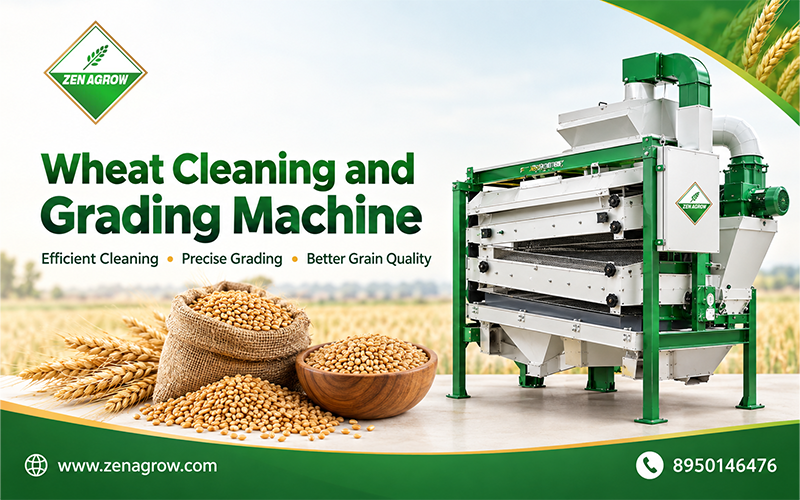
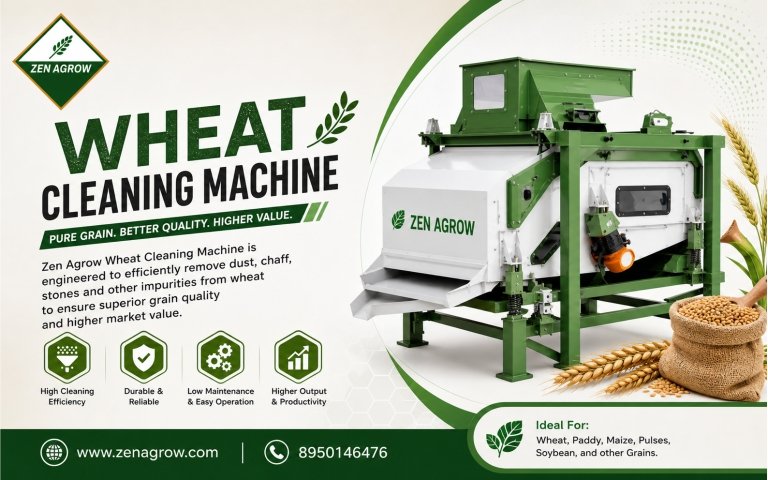
3. How is a grain grading machine different from a grain cleaning machine? A cleaning machine primarily removes dust, chaff, and foreign material. A grading machine, however, goes further by sorting grain into distinct size and quality categories for better market pricing.
4. What is the average capacity of a commercial grain grading machine? Capacity varies widely depending on the model. It can range from a few hundred kilograms per hour for small units, to several tons per hour for industrial-grade machines.
5. Does using a grain grading machine improve selling price? Yes, it does. Uniformly graded grain typically commands a higher price in mandis and export markets, compared to ungraded or mixed-quality batches, since buyers pay a premium for consistency.
6. How often should a grain grading machine be maintained? Ideally, routine maintenance, including sieve cleaning and lubrication, should be performed weekly during active use. In addition, a thorough inspection should be done before and after each harvest season.
7. Is it worth investing in a grain grading machine for a small farm? Yes, it usually is. Even small and medium farms benefit significantly, since reduced post-harvest losses and better pricing on graded grain often help recover the machine’s cost within a few harvest cycles.
Final Thoughts
A grain grading machine is no longer a luxury reserved for large agribusinesses. Instead, it has become a practical necessity for farmers and processors of every scale, who want to secure better market prices, reduce post-harvest losses, and meet rising quality expectations. From size-based sieving to advanced optical sorting, the technology behind grain grading machines continues to evolve. As a result, each new generation offers more precision and efficiency than the last. According to the Food and Agriculture Organization (FAO), grain grading and quality standards play an important role in quality assurance, marketing, and determining grain value.
If you’re looking to upgrade your post-harvest infrastructure, partnering with an experienced and reliable manufacturer makes all the difference. As trusted Agricultural Machinery Manufacturers, Zenagrow offers durable, high-performance grain grading machines designed to meet the real-world demands of Indian farms and processing units. So, explore our complete equipment range at https://www.zenagrow.com/, and take the next step toward smarter, more profitable grain handling.


 English